Found family
The Journey CollectionFound family is the story’s central image for a household created through deliberate belonging rather than preserved by blood alone. Travis McCoy returns to Clarendon carrying grief, resentment, and the knowledge that he has missed ten years of Max’s life, but the family he eventually forms with Penelope Stone and Max is not simply recovered from the past. It is built through promises, difficult disclosures, repaired parent-child bonds, marriage, and the arrival of a new child. The resulting family joins biological connection to chosen commitment: people become family by accepting one another’s histories and continuing to show up for one another.
A Family Interrupted by Silence
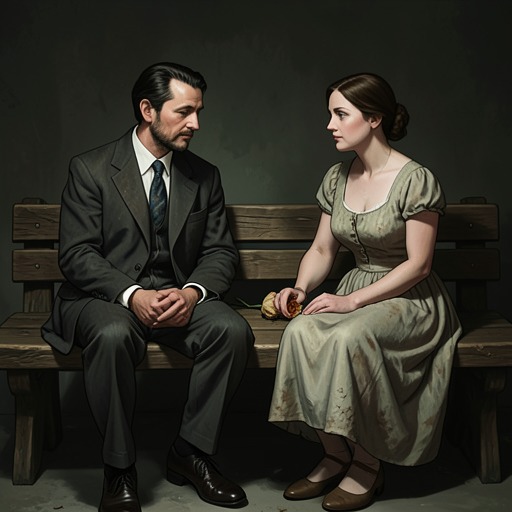
The need for a found family is rooted in several forms of absence. Travis leaves Penelope when they are young, believing that professional football must come before every other future, and his departure crushes the woman who had believed in him most completely. Penelope later explains that she did not know she was pregnant when he left; by the time she discovered the pregnancy, two months had passed, her parents were furious, and she was frightened by the certainty that Travis had already chosen a life without her. She tried to tell him, even driving to Austin, but the separation and his earlier insistence that they should see other people prevented the family from forming openly.
Travis’s own childhood gives this silence an older and more painful context. Loralie McCoy dies of Acute Lymphoblastic Leukemia after Travis watches her endure two years of illness and chemotherapy. He is nine when she is diagnosed and eleven when she dies. He blames Russ McCoy for spending time in his workshop instead of caring for his dying wife, and he carries that accusation into adulthood. The family he returns to is therefore fractured across generations: a dead mother, an estranged father, a hidden son, and a former love separated by a decade of decisions that were never fully explained.
Max and the Package Deal
Max is the person who transforms the possibility of family into an immediate demand for belonging. After learning that Travis is his father, Max does not treat the discovery only as a revelation of biology. He responds to Travis’s presence as an opportunity to create the family he has not had. When Penelope worries about the consequences of the past, Max interrupts her reassurance that he is not angry and declares that Travis is there now, so they can be a real family. Travis answers by promising that they can.
The family’s defining formula comes later, when Travis assures Max that he will not abandon him. Travis tells him that he, Max, and Penelope are a “package deal,” because none of them works without the others. Max develops the image into a puzzle: all the pieces are needed to make the picture whole, although he immediately identifies one absent piece by asking for a little brother or sister. The exchange makes family an active structure of mutual dependence. It also reverses Travis’s earlier fear that fatherhood would trap him in a life he had not chosen. Max does not represent the end of Travis’s dream; he becomes the person through whom Travis learns that love can enlarge, rather than cancel, a future.
Max’s confidence also helps Travis change his understanding of fatherhood. Travis recognizes that Max knew almost immediately that he was his son, yet was not afraid of him. In Travis’s judgment, Max possesses a courage and self-confidence that he lacked at eighteen, when praise and ambition made him arrogant and caused him to put football above the people who loved him. Max is therefore not merely the child Travis failed to raise. He becomes a moral influence on his father, a living reminder that bravery means accepting love instead of fleeing from its obligations.
Reconciliation Across Generations
The found family extends beyond the household Travis makes with Penelope and Max. Travis initially confronts Russ with anger, demanding to know why his father concealed Max’s existence. That confrontation forces the family’s old secrets into direct speech. Penelope explains why she had hidden the pregnancy, while Russ must face the consequences of having allowed Travis to grow up without the knowledge that he had a son. The family cannot be rebuilt through sentiment alone; it requires the painful exposure of the choices that damaged it.
Russ’s letter becomes a second form of repair. In it, he remembers a moment when four-year-old Travis begged to accompany him on the tractor. Russ had intended to postpone the promise, but Loralie warned him that his son would be gone before he knew it. When Russ later found Travis asleep with a picture of the two of them clenched in his hand, the sight forced him to recognize how deeply his son needed him. He took Travis into the field, and the letter finally states what he had failed to say often enough: that he has always been proud of Travis and loves him. The letter does not erase Russ’s failures or Loralie’s death, but it gives the estranged father and son a language in which love can exist beside regret.
Travis’s later account of his own youthful behavior completes the generational exchange. He admits that he ended things with Penelope because he feared she would eventually realize he was a fool and leave him, so he chose to hurt her first. Russ reframes that decision as the fear of an eighteen-year-old rather than an unchangeable definition of Travis’s character, telling him that he cannot alter the past but can learn from it and teach Max not to repeat it. Found family thus includes the transmission of hard-won knowledge: reconciliation is not only a return to affection, but an effort to prevent inherited patterns of abandonment from passing to the next generation.
Public and Private Belonging
The idea of family is reinforced through communal ritual. When Travis leads the Clarendon Broncos onto the field, he discovers that the homecoming crowd affects him more deeply than the professional stadiums where he once played before enormous audiences. At the fifty-yard line, he understands the crowd’s embrace as the meaning of being home. He tells the players that the cheers belong to them because they have worked for the community’s respect, and he insists that their value does not depend entirely on winning. The scene places Travis inside a broader found family: the team, its supporters, and the town are joined by shared effort and recognition.
That public belonging prepares the way for private ceremonies. Travis proposes to Penelope with the black velvet ring box he keeps ready, telling her that he has loved her since he was fourteen and that she has always owned his heart and soul. Her acceptance converts their recovered relationship into a committed future. Their marriage then gives formal shape to the household Max had already imagined, joining the couple’s renewed love to Travis’s responsibility as a father.
The same process appears in Russ’s relationship with Nadine Malone. After remembering his long love for Loralie, Russ acknowledges that moving forward does not mean ceasing to love his dead wife. He tells Travis that he intends to propose to Nadine and asks whether Travis can accept that future. Travis’s support allows Russ to enter another stage of family life without treating remarriage as betrayal. Later, Travis escorts Nadine to Russ and places her hand in his father’s, advising Russ simply to love her. The gesture makes Travis an active participant in the reconfiguration of the older generation, no longer only the injured son demanding an account.
Expansion, Continuity, and Meaning
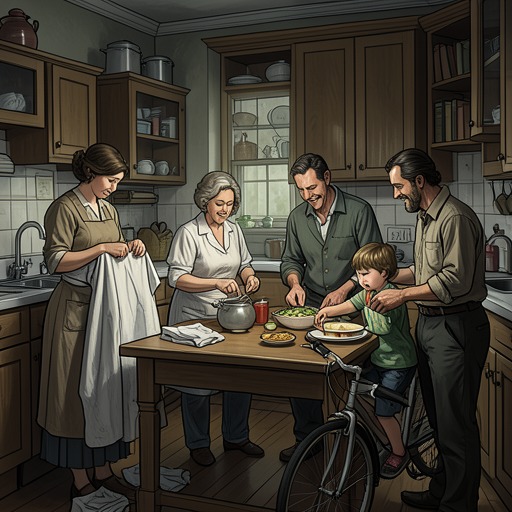
By the family meal after Penelope’s pregnancy is announced, the household has expanded into a visible network of relationships. Russ and Max tease each other while piling food onto their plates, Nadine asks Penelope about her condition, due date, and possible names, and Travis observes a family that now includes a mother, a father, a son, a wife, and a baby on the way. The scene’s abundance contrasts with the earlier emptiness of the McCoy home and with Travis’s former belief that success on the football field could substitute for emotional permanence.
The birth of Loralie makes that transformation concrete. When Penelope’s water breaks, Travis reacts with alarm and immediately turns toward her, placing one hand around her waist and the other on her belly as they prepare to contact Dr. Edward Chan and go to the hospital. His response is the opposite of the absence that defined his childhood and early adulthood: he is physically present at the crisis and emotionally involved in the family’s next transition.
After the birth, Travis lifts the baby from her bassinet and tells Penelope that she has given him a family. He places their daughter in Penelope’s arms, notices that she resembles Loralie, and names her Loralie. The name turns memory into continuity without reducing the new child to a replacement for the dead mother. It links the generations through love while preserving the new family’s distinct future. Found family therefore does not mean that blood and ancestry are irrelevant. Rather, it shows that biological ties become meaningful when they are accompanied by recognition, care, forgiveness, and chosen permanence. The final family is whole not because its history was never broken, but because its members decide to become one another’s missing pieces.